Learning Goals
- Deep Conceptual Understanding: Investigate how a mathematical concept operates within a real-world domain students genuinely care about.
- Guarded AI Collaboration: Practice structured AI use by asking purposeful questions, challenging outputs, and connecting ideas rather than accepting answers passively.
- Metacognitive Awareness: Develop thoughtful questions for the AI tool by clarifying uncertainties, identifying what is already understood, and determining what support will move thinking forward.
- Increased Engagement & Relevance: Experience mathematics as personally meaningful by situating concepts within interesting, authentic contexts.
- Higher-Order Thinking: Move beyond procedure to apply, analyze, evaluate, and synthesize mathematical ideas within real-world situations.
- Mathematical Self-Efficacy: Strengthen confidence by using AI strategically to support understanding.
Supporting Research
Materials
- One target mathematical concept (ex: solve a quadratic equation, systems of equations, vectors)
- One LLM software account per student (ex: ChatGPT, Gemini — free version works)
Deliverable
- Submit the AI conversation (chat transcript).
- One-paragraph reflection or discussion summary responding to:
- What real world applications of [math_topic] did you discover?
- Does this understanding increase your appreciation of [math_topic]?
Lesson Structure
[10 mins] Establish the Activity + Purpose + AI-Forward Skill
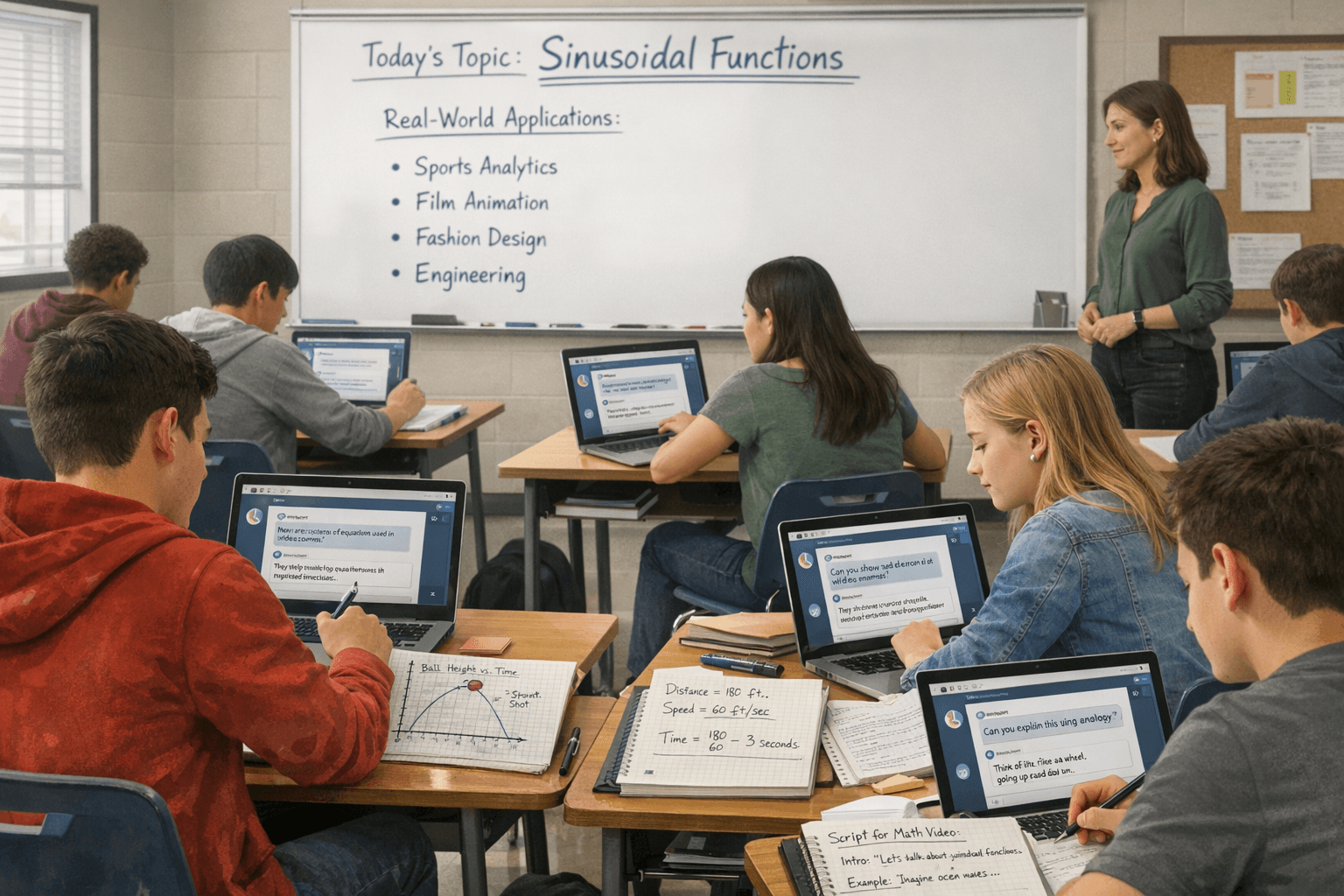
Say: “Our activity is focused on exploring how [math_topic] is used in the real world in the context of something meaningful to you. Today, each of you will use AI to explore [math_topic] use cases in an area that you are interested in, and present your findings to the class.”
Walk students through an example AI conversation where you develop a deep understanding of a real-world application.
Model:
- Asking precise, layered questions
- Requesting clarification when something is unclear
- Pressing for conceptual understanding, not just examples
Refer to the Video below for prompting ideas.
[20 mins] Individual Deep Dive with AI
Students begin by asking:
How is [math_concept] used in [area_of_interest]?
Example starting questions:
- How are quadratic equations used in the Coco movie?
- How do systems of equations show up in video games?
- How do fashion designers use geometric transformations in clothing patterns and tailoring?
- Are exponential equations used in sports? If so, how?
- How are sinusoidal functions used in the real world? Please provide examples that might be interesting or relevant to a 16-year-old student living in California.
Follow-up question iedas:
- Can you show example calculations using realistic values?
- Can you give a specific example of a company, product, or film that uses this math concept?
- When would one method be better than another for this use case?
- Can you provide an analogy to clarify how [math_topic] works?
- What assumptions are being made in this application?
Student must ask at least:
- One clarification question
- One applied example in their chosen domain
- One question about assumptions, limitations, or possible errors
Students focus on understanding the application well enough to reteach it to a friend.
[15–20 mins] Share + Reflect
Call on students to share:
- Their domain of interest
- One key insight about how the math is used
- A tangible example worked out on the board
- One way their understanding of the concept shifted
Invite other students to ask clarifying questions.
Highlight how a single mathematical concept can appear across multiple domains, representations, and problem types.
Close by reinforcing the central idea: mathematics is not isolated—it is embedded in design, media, engineering, sports, art, cooking, etc. When students see this, math becomes meaningful, tangible, and necessitated.
Appendix
A. Video explaining the lesson overview and prompting strategies: