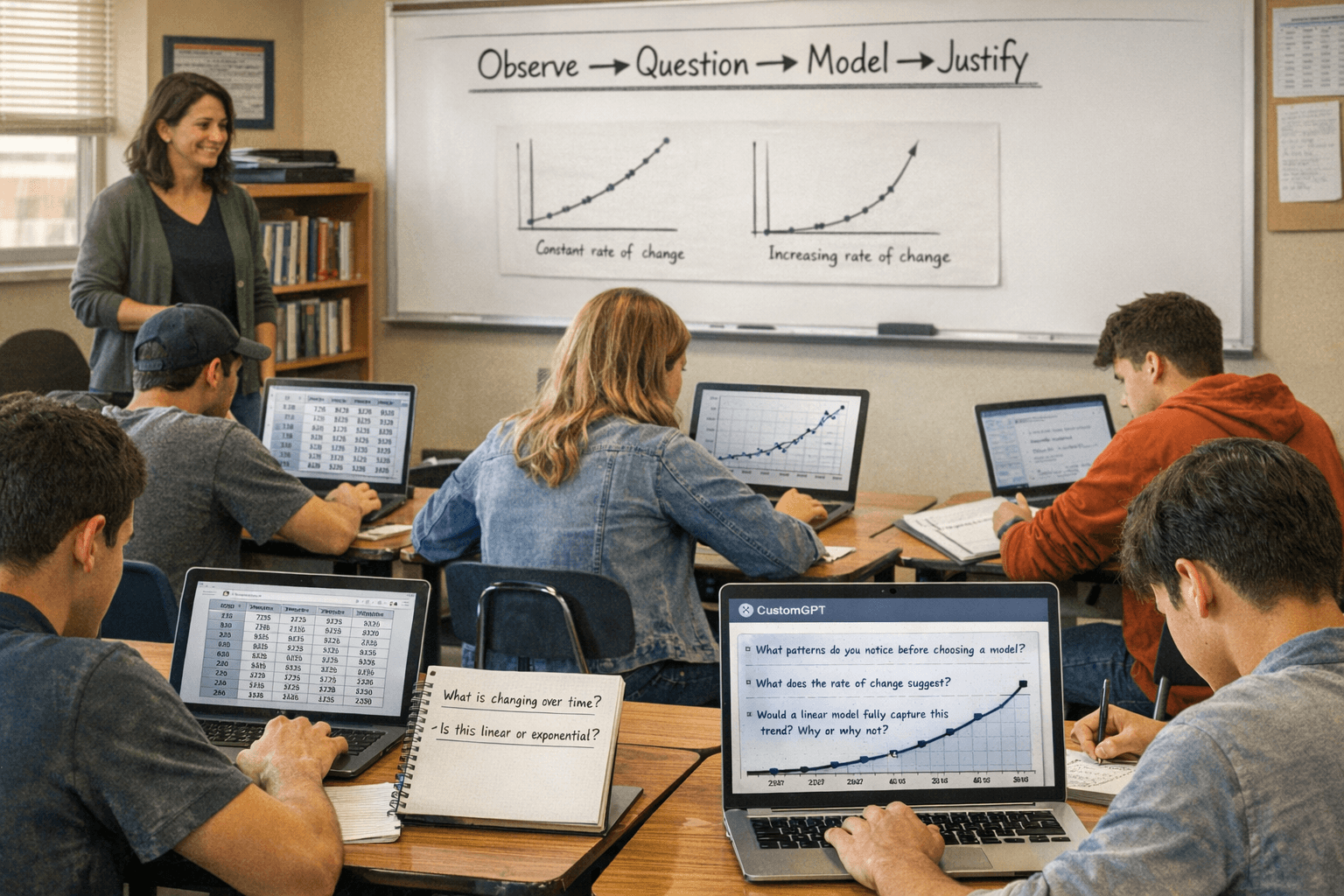
Lesson Overview:
In the real world, mathematics begins with observations—not formulas or procedures. The important work is deciding what the data might be saying, and which mathematical concepts clarify the story. In the AI Era, sense-making, trend identification, and pattern recognition matter more than information recall. This activity centers those skills: students observe data, notice patterns, make modeling choices, and justify their reasoning.
This activity is ideal when introducing a new function family, during a data analysis unit, or as concept consolidation.
Learning Goals
Students will:
- Develop Mathematical Sense-Making: Interpret real-world data to identify patterns, trends, and relationships before selecting or applying a mathematical model.
- Practice Mathematical Judgment: Choose which mathematical concepts describe the data and justify those choices in context.
- Guarded AI Collaboration: Engage a customGPT as a thought partner to surface questions, clarify thinking, and refine explanations.
Supporting Research
Materials
- One teacher-selected dataset showing a clear trend over time. Kaggle is a great resource for finding datasets. (ex: sports statistics by season, global population growth, company sales by year, climate indicators)
- ChatGPT account with access to the shared CustomGPT: Data Analysis Thought Partner
Task + Deliverable
Each student is given the same real-world dataset. Using the data, students interact with the shared customGPT to explore:
- What patterns or trends they notice
- What mathematical ideas might describe those trends
- What the math is doing conceptually (describing change, comparing quantities, modeling growth, identifying rates, etc.)
Students use AI not for answers—but to sharpen observation, question assumptions, and strengthen justification.
Deliverable options:
- A written explanation of the observed pattern, chosen model, and justification
- A submission of the ChatGPT conversation.
Lesson Structure
[10 mins] Establish Purpose + AI-Forward Skill
Frame the lesson: We are living in a time with access to more data than ever before.
Ask students:
- Where does data show up in your life?
(sports, social media metrics, climate news, business reports, fitness tracking, etc.)
Explain that in the AI Era, memorizing isolated facts matters less than recognizing patterns and making sound decisions. Large Language Models are trained on vast information—but reasoning and judgment still belong to humans.
Introduce the customGPT as a guided reasoning partner. It is designed to help students:
- Identify patterns
- Surface overlooked insights
- Connect observations to Algebra 2 concepts
Position it as a digital tutor that listens to their thinking and pushes it further.
[25–30 mins] Individual Data Exploration + AI Partnership
Step 1 — Human-First Thinking (No AI Yet)
Before opening ChatGPT, students first engage independently.
Teacher framing: “Before you open ChatGPT, spend a few minutes just looking at the data. Don’t label anything yet. Just observe and try finding patterns.”
Then: “Write down anything that stands out. What seems to be changing? What surprises you? What questions do you already have?”
Only after this initial observation phase do students open the customGPT and begin interacting.
Step 2 — CustomGPT as a Learning Partner
Students now open a ChatGPT chat conversation with the customGPT. The customGPT will:
- Prompt students to articulate patterns
- Ask clarifying questions
- Suggest possible function families
- Press for conceptual reasoning
Students refine their thinking through dialogue.
[10–15 mins] Sharing + Sense-Making Discussion
Invite students to share:
- A pattern they noticed
- The mathematical model they believe represents it
- Why that model makes sense
Ask students to share any visuals they created.
Close by reinforcing the core idea: mathematical functions and formulas emerge from patterns we observe and use to model the world.