The recent proliferation of Generative Artificial Intelligence (GenAI) is transforming work: bringing a wave of new jobs, redefining workplace operations, and demanding new skills of the future workforce. It is so powerful that the effects are seen across industries, and unlike past technologies, GenAI impacts the most prestigious professions (medicine, law, programming, etc.) A key question is how education is responding to prepare students for this new era.
To understand what teachers must now prioritize, it helps to examine how AI is reshaping work. An analysis by SHRM and The Burning Glass Institute suggests that AI will impact jobs through three primary pathways: automation, augmentation, and transformation.
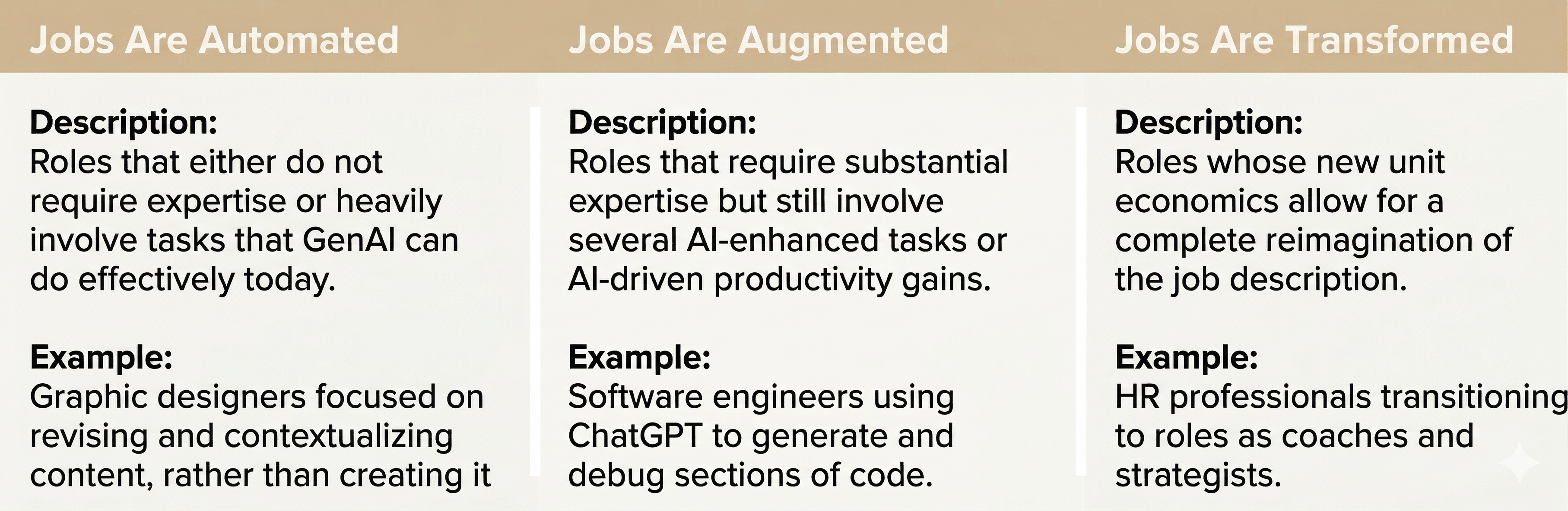
Value is shifting toward the skills that complement AI’s speed and efficiency. Across industries, six shifts are emerging:
- Judgment over execution — Discernment and critical thinking matter more than routine task performance.
- Orchestration over individual contribution — The ability to coordinate tools, data, and people becomes central.
- Sense-making over information recall — Pattern recognition, approximation, and synthesis take priority over memorization.
- Ethical decision making — Human judgment is required to evaluate context and consequences.
- Innovation and creative thinking — AI recombines existing knowledge; originality still depends on human direction.
- Learning to learn — Metacognition, adaptability, and continuous learning become foundational.
Interestingly, all of these skills map directly onto what strong mathematicians already do. Highly respected educators are calling for more focus on students’ process behind their answer, emphasizing skills like strategic planning, monitoring understanding, error detection, pattern recognition, flexible strategy switching, and justification (Math-ish, Boaler,2024). The most valuable mathematical competencies are increasingly metacognitive and judgment-based because they not only determine whether a student can reach an answer but also help students think about and solve real problems successfully.
This alignment between the demands of mathematics and the demands of an AI-driven future makes change in mathematics education particularly urgent. Math class has traditionally been focused on whether students can achieve the right answer. However, since large language models (LLMs) can readily achieve the correct answer, we can no longer focus on the solution as the end goal of math. To emphasize the research, this places the importance on how students are thinking about math, and their process for developing mathematical conclusions.
As Tom Chatfield argues, learning is the one process that cannot be automated or outsourced. No matter how advanced AI becomes, it remains a component within a larger system whose success is measured in human understanding and agency. The process is the purpose. This reframes AI as a catalyst, if used intentionally.
While AI is transforming what students need to learn, it does not change what it means to learn, and how students learn best. As we foster learning in the AI Era, we must intentionally create opportunities for metacognition, critical thinking, creativity, and agency. This deep, human thinking process required by these skills builds unique capabilities that no system can replace.
Appendix: Classroom Applications for the AI Era
Below are two practical lesson plans that intentionally foster these future-oriented skills.
Data-Driven Math
Summary: Students observe data, notice patterns, make modeling choices, and justify their reasoning.
Learning Goals:
- Develop Mathematical Sense-Making: Interpret real-world data to identify patterns, trends, and relationships before selecting or applying a mathematical model.
- Practice Mathematical Judgment: Choose which mathematical concepts describe the data and justify those choices in context.
- Guarded AI Collaboration: Engage a customGPT as a thought partner to surface questions, clarify thinking, and refine explanations. AI Role: Supports exploration, pattern identification, and explanation—not final answers
Multiple Solution Paths
Summary: Solve one problem in multiple ways using AI as a thought partner. Learning Goals:
- Mathematical flexibility, sense-making, and deeper conceptual understanding: As students explore and articulate multiple representations of the same idea (symbolic, graphical, numerical, contextual), they gain strategies to verify a solution is logical. This supports sense-making, retention, and conceptual understanding.
- Strategic mathematical thinking: Students will compare solution methods, analyze their strengths and limitations, and justify which approach is most useful in a given context.
- Productive AI collaboration: Students will engage with AI as a structured reasoning partner that prioritizes student thinking first, helps students understand the multiple approaches, and supports reflection. This ensures students extend and clarify their reasoning rather than delegate it.