Learning Goals
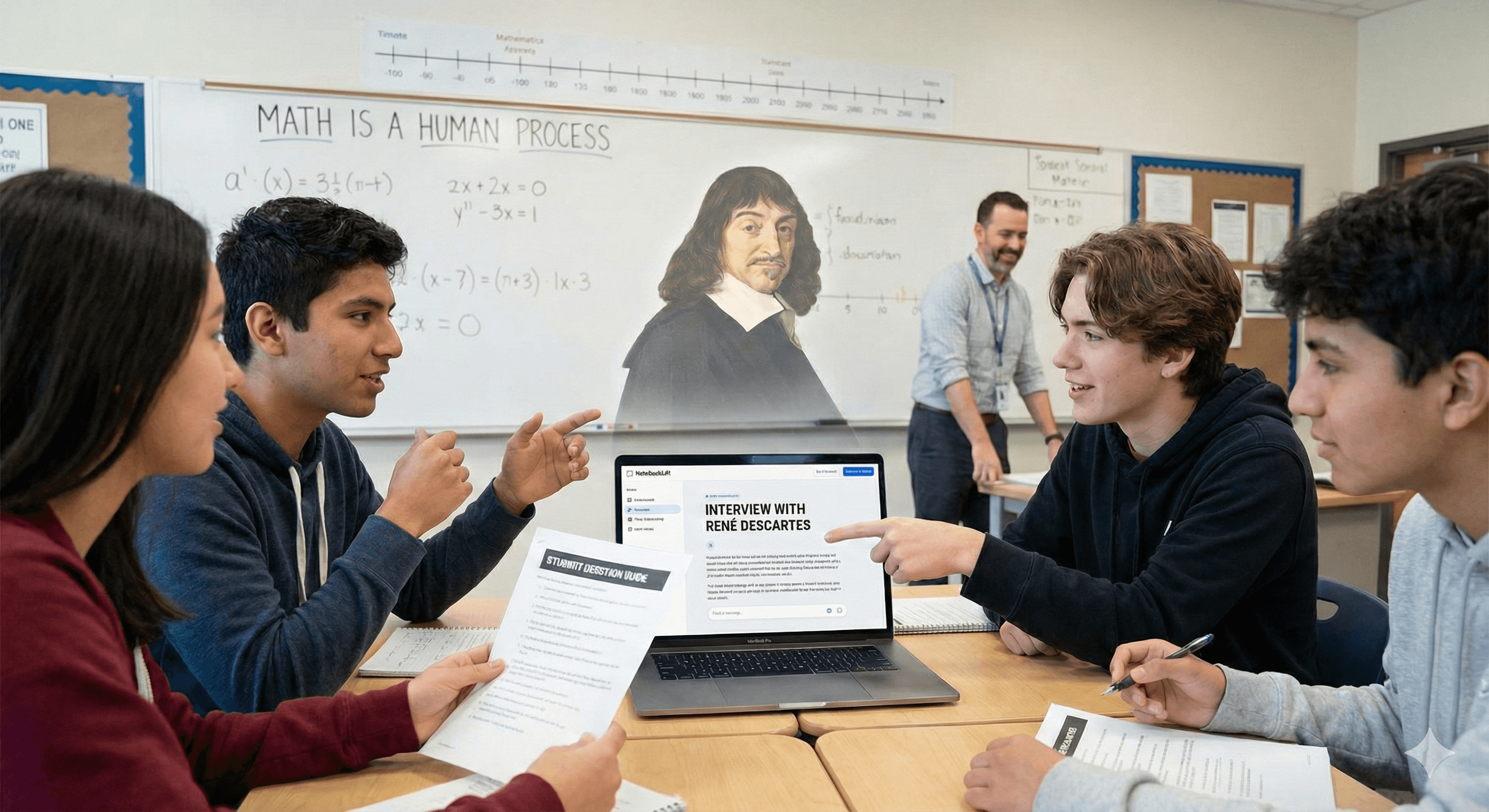
- Humanize Mathematics: Students understand math as a human, iterative process to improve interest and sense-making.
- Dialogic Learning: Students ask thought-provoking questions, clarify uncertainties, and challenge disagreements.
- Contextual Motivation: Students connect abstract ideas to real-world problems they were designed to solve.
Supporting Research
Materials
- Approximately 3 sources about a particular mathematician
- One NotebookLM account per group
- Student Question Guide
Task
Students work in groups on one computer. Each student must ask at least one question to the mathematician.
Deliverable
A one-paragraph reflection discussing what stood out and how the interview impacted their perspective on mathematics.
Lesson Structure
[5 mins] Establish Activity + Purpose
- Say: "Today you are investigating how [math concept] came to exist, and why someone had to invent it."
- Ask: "Before [mathematician name], people had to [state the condition of math before]. What problems do you think that created?"
[8-10 mins] AI-Forward Skill
- Model how to ask good questions using the Student Question Guide
- Challenge students to move beyond facts and ask questions that uncover reasoning, motivation, and impact.
[20 mins] Dialogue with the Mathematician
- Upload sources to NotebookLM.
- Paste the Audio Customization Prompt.
- Activate Interactive Mode and have each student ask 2 questions.
[15 mins] Group Reflection
- Discuss or write the paragraph response.
- Focus on: "What problem did this new way of thinking solve, and how does that solution show up in math today?"
[10 mins] Full Class Reflection
- Each group shares one question that changed their thinking about the topic.
Appendix
A. Student Question Guide
Use this guide to help students move beyond factual recall and toward reasoning, clarification, and meaning-making.
Clarifying
- "When you say ___, what exactly do you mean by that?"
- "Can you restate that idea in a simpler way?"
- "Can you give a concrete example of what you’re describing?"
Pressing for Reasoning
- "What problem were you trying to solve when you developed this idea?"
- "Why was this better than the methods people were already using?"
- "How did you know you were on the right track?"
Challenging Assumptions
- "What were you assuming that others didn’t accept?"
- "What did people disagree with when you first shared this idea?"
- "How did you respond to criticism or doubt?"
Gathering Meaning
- "What are you most proud of in your career?"
- "What advice would you give to someone struggling with math today?"
- "What do you think mathematics says about how humans think?"
B. Audio Customization Prompt
Copy and paste into NotebookLM:
Create an interview-style conversation for high school students. The host with the [male/female]-sounding voice should be [Mathematician_name], speaking in the first person, grounded strictly in the sources in this notebook. The other host should be a curious interviewer representing a thoughtful student or teacher.
Focus on:
- How mathematical ideas are created, not just the final results.
- The questions, doubts, and problems that led to their math discovery.
- Moments of uncertainty, revision, and struggle.
The Mathematician should:
- Explain why they developed ideas, not just what they are.
- Describe their method of thinking.
- Reflect on what people misunderstood at the time.
The Interviewer should:
- Ask follow-up “why” and “how do you know” questions.
- Press for clarification on assumptions and motivations. Avoid lecturing. Model a dialogue where ideas are explored and challenged.